
In early 2023, a high-altitude Chinese surveillance balloon drifted into U.S. airspace. The balloon spent days crossing the continent before an F-22 shot it down off South Carolina. U.S. officials later stated that this was just one node in a broader People’s Republic of China balloon program, and that similar craft had flown over more than 40 countries across five continents.
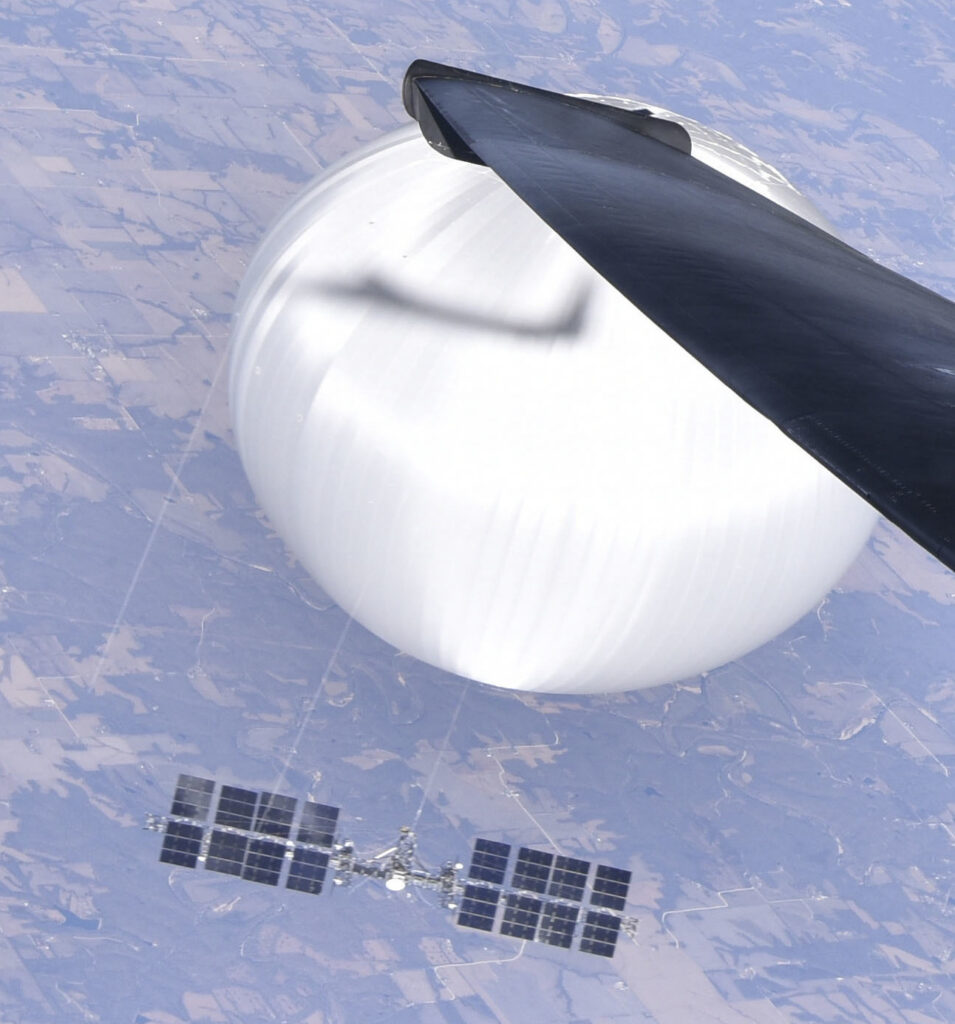
For most people, that episode felt like something out of a Cold War thriller gone slightly low-tech. But for anyone who lives in the world of aerial imagery, it was a pointed reminder that balloons have been intelligence platforms for more than two centuries. Long before satellites and spy planes, balloons were the original high ground. They were used to watch troop movements, sketch enemy positions, and, eventually, to carry cameras into the sky.
This first installment of Balloons of War looks at how that idea emerged in Europe, crossed the Atlantic, and very nearly produced aerial photographs of the American Civil War—but didn’t.
Revolutionary France: Watching a Battlefield from Above
Military ballooning is almost as old as ballooning itself. The Montgolfier brothers launched the first manned flights in 1783. By the 1790s, French revolutionaries were asking the obvious question: what could you see from up there in a war?
At the Battle of Fleurus in 1794, the French army deployed L’Entreprenant, a tethered balloon staffed by trained observers. From their basket above the battlefield, aeronauts watched Austrian and Dutch movements and sent down reports, sometimes via semaphore, sometimes via written notes slid down the tether. The experiment was successful enough that France formalized a dedicated balloon unit, the Compagnie d’Aérostiers.
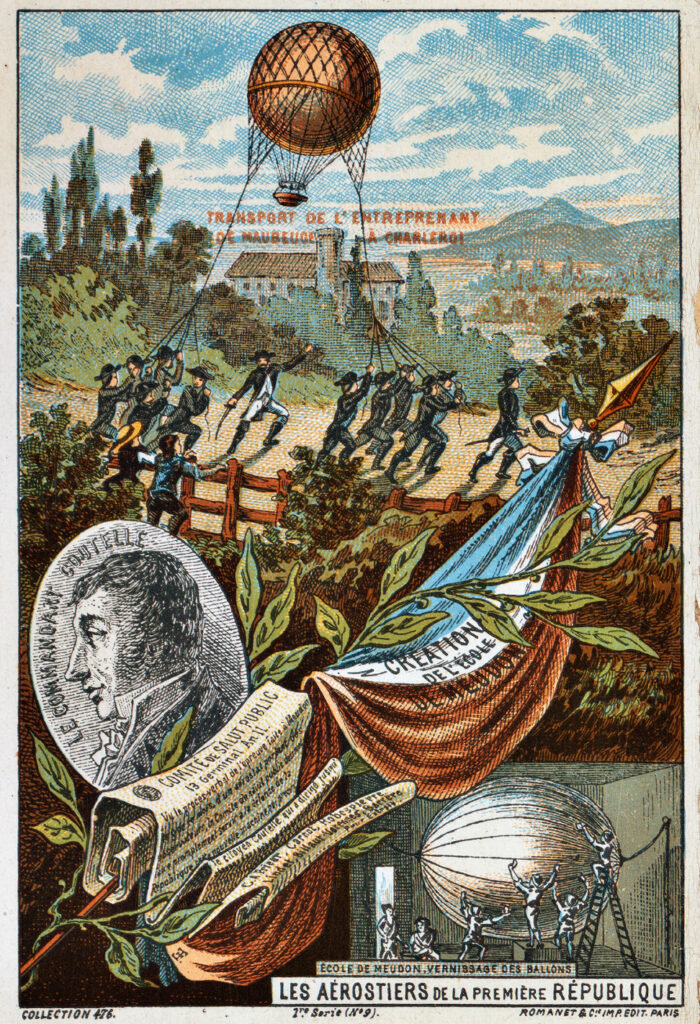
It didn’t last. Napoleon, focused on mobile campaigning and skeptical of anything that slowed him down, disbanded the balloon company by 1799. For decades, military ballooning slumped into the category of “interesting, but not essential.”
The idea, however, was now out in the world: a higher vantage point could change the way you understood a battlefield.
Nadar’s Dream: Cameras, Balloons, and War
By the mid-19th century, a new technology arrived to complicate the story: photography.
In France, the photographer and showman Gaspard-Félix Tournachon—better known as Nadar—saw the possibilities before almost anyone else. In 1858 he combined his ballooning hobby with his camera, making what is widely recognized as the first aerial photograph, taken from a tethered balloon above the village of Petit-Bicêtre near Paris.
Nadar went further than just taking a picture. He filed a patent for “aerostatic photography” in 1858, explicitly pitching the method for surveying, mapping, and strategic reconnaissance. In his own accounts he described the core problem bluntly: even a captive balloon basket swayed “from back to front, from left to right… and from bottom to top,” turning long-exposure wet-collodion photography into a small nightmare of motion blur and timing.
Still, the foundation was laid. Aerial views were no longer theoretical sketches from high ground; they were photographic images you could study, copy, and compare.
In 1860, just across the Atlantic, American photographer James Wallace Black took the earliest surviving aerial photograph of a city, Boston, as the Eagle and the Wild Goose See It, from a tethered balloon at about 1,200 feet.
By the time the U.S. fractured in 1861, both balloons and cameras had proven they could work together—at least over a cooperative city.
The American Civil War: Scramble for the Sky
When the Civil War broke out, a small fraternity of American aeronauts immediately tried to sell their skills to the Union. Among them were:
- John Wise, a veteran balloonist and scientific experimenter, who had long promoted ballooning for meteorology and exploration.
- John LaMountain, a hard-driving showman-aeronaut who flew early reconnaissance ascents over Confederate positions near Fortress Monroe in 1861, essentially freelancing aerial intelligence for Union commanders.
- Thaddeus Sobieski Constantine Lowe, who had been preparing a transatlantic balloon attempt when war intervened.
Lowe was the one who ultimately secured President Lincoln’s backing. In June 1861, he ascended over Washington, D.C., in his balloon Enterprise with a telegraph line running down the tether. From about 500 feet, he wired the White House a live report of what he could see across the countryside. This was effectively the first American demo of airborne ISR.
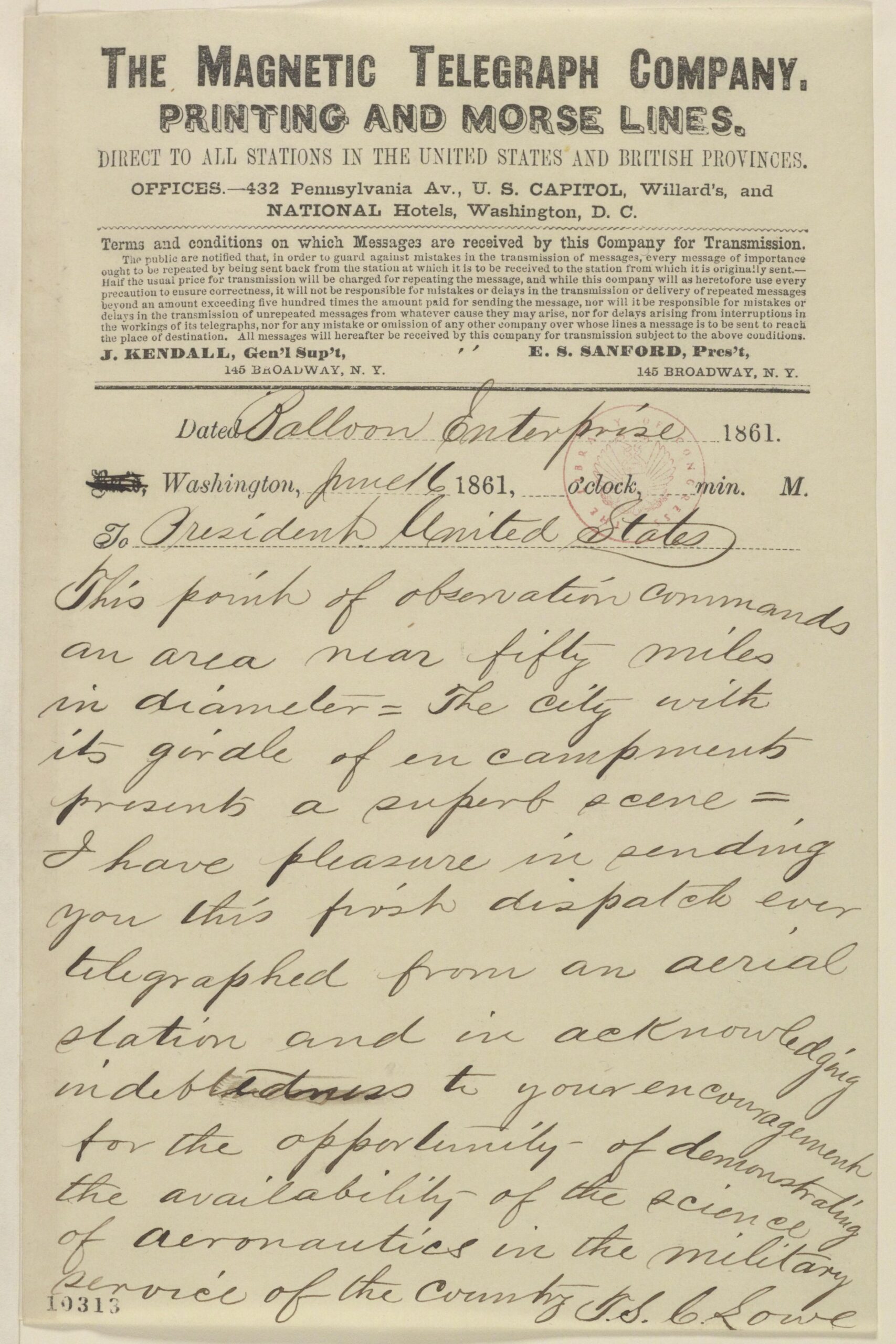
Balloon Enterprise
T. S. C. Lowe
June 16 1861
This point of observation commands an area near fifty miles in diameter—The city with its girdle of encampments presents a superb scene—I have pleasure in sending you this first dispatch ever telegraphed from an aerial station and in acknowledging indebtedness to your encouragement for the opportunity of demonstrating the availability of the science of aeronautics in the military service of the country
Lincoln was impressed. On his recommendation, the War Department authorized what became the Union Army Balloon Corps, with Lowe as chief aeronaut.
How the Balloon Corps Actually Worked
From 1861 to 1863, Lowe and his colleagues operated a small fleet of hydrogen balloons—Union, Intrepid, Constitution, and others—primarily in the Eastern Theater. They ascended over:
- The defenses of Washington after First Bull Run
- The Peninsula Campaign, including Yorktown, Gaines’ Mill, and Seven Pines / Fair Oaks
- Later operations near Antietam and Fredericksburg
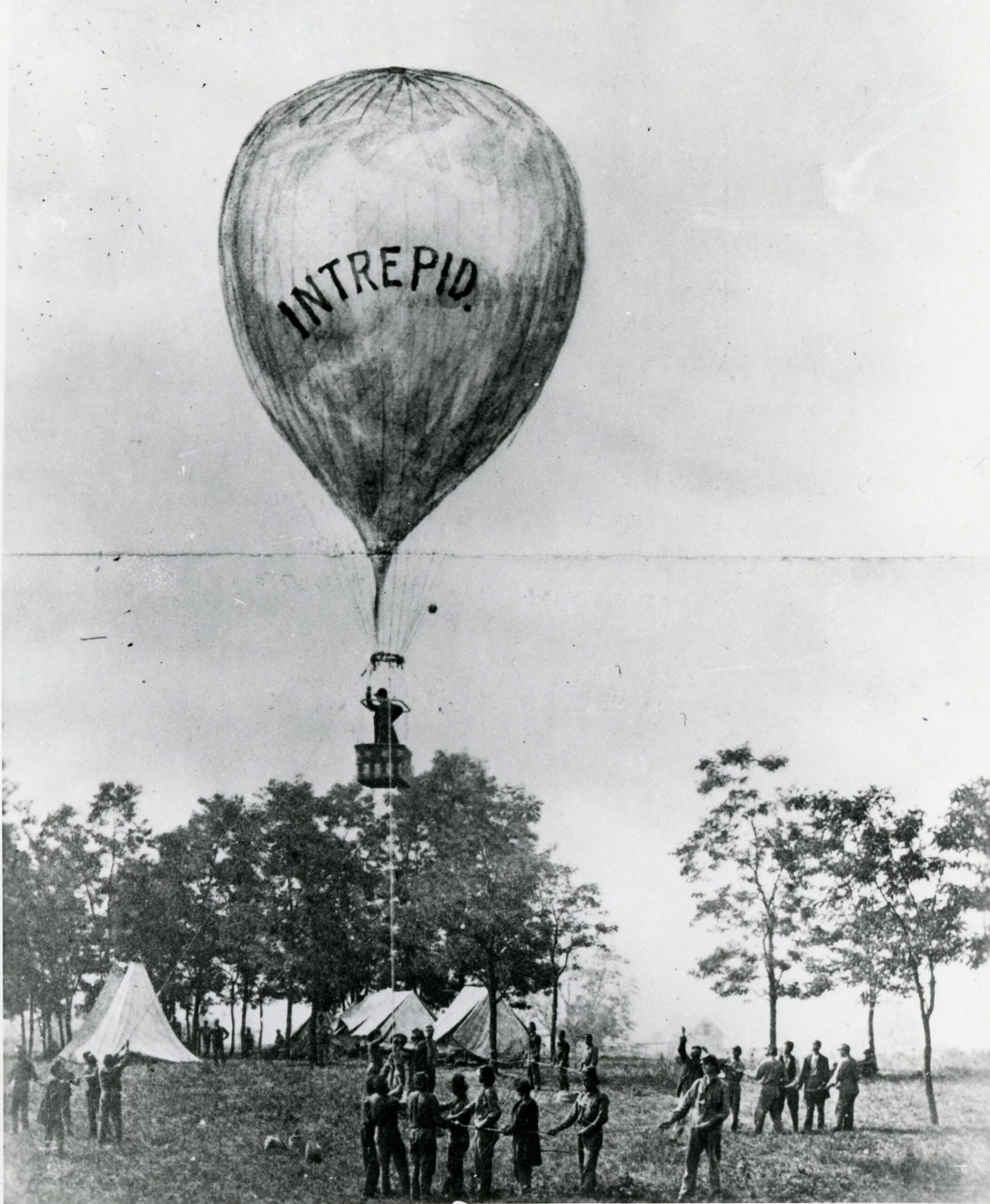
From roughly 1,000 feet up, observers spotted trenches, artillery batteries, campfires, and troop movements. Messages could be sent down three ways:
- Telegraph, using cables run along the tether to a field station
- Signal rockets and flags, coordinated with the Signal Corps
- Written notes clipped to a ring and slid down the tether cable
Portable hydrogen and wagons make reconnaissance portable
In and near major cities, balloons could be filled using municipal gas works—fast, if you were close enough to the infrastructure. But war is rarely kind enough to keep the fighting where the pipelines are. To operate in the field, Lowe designed portable hydrogen generators: wagons carrying iron filings and acid tanks that could produce gas on site. These generators allowed the Balloon Corps to follow the Army of the Potomac into the Virginia countryside, though at the cost of significant logistical complexity and hours-long inflation times.
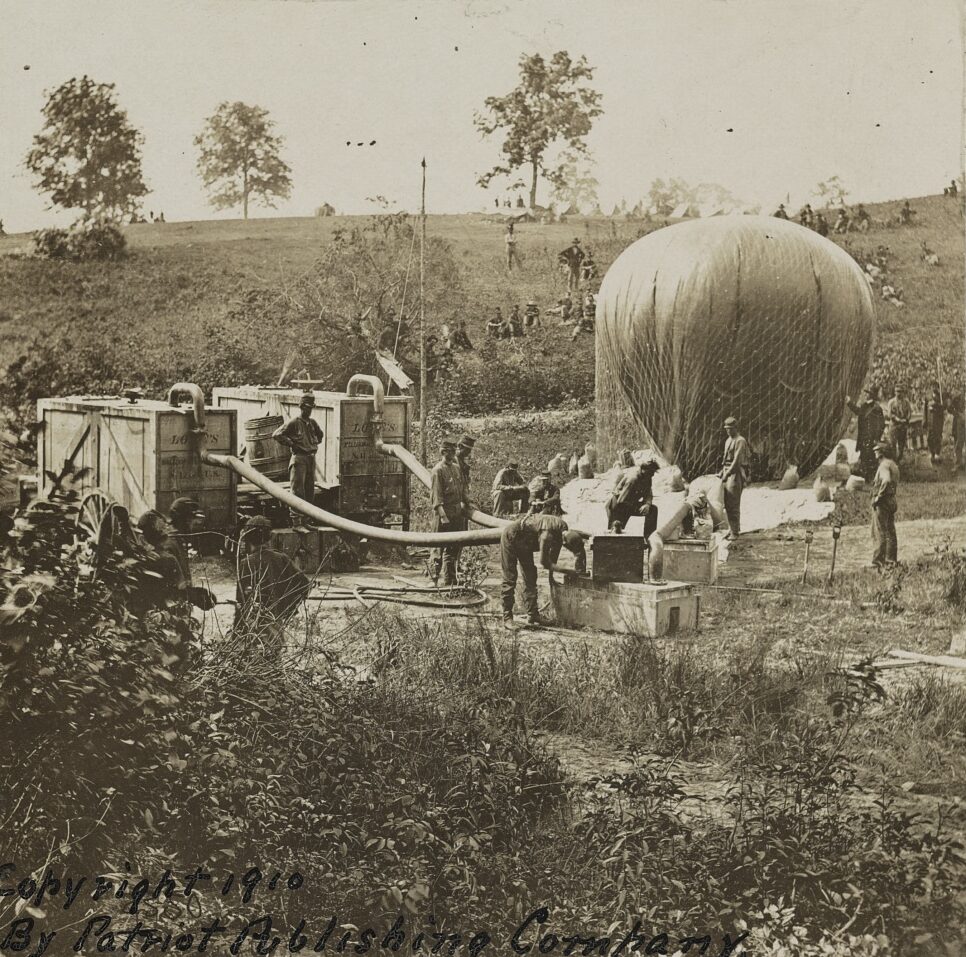
Other aeronauts played important roles:
- John LaMountain continued to make reconnaissance ascents for the Union early in the war, helping prove the concept before formal structures were in place.
- James Allen, another experienced balloonist, eventually took over many operational duties when Lowe’s position weakened in 1863, keeping the last ascents going as the Corps slid into bureaucratic neglect.
By mid-1863, the Balloon Corps was quietly disbanded. The reasons were a mix of Army politics, funding issues, and the simple friction of maintaining a new technology inside a conservative institution. But the concept was now proven: a view from above could change how generals planned and fought.
Why We Don’t Have Civil War Aerial Photographs
Given all of this, aerial-imagery people eventually ask the same question you probably have:
“If Nadar took aerial photos in 1858, and James Wallace Black photographed Boston from a balloon in 1860, why don’t we have any aerial photographs from Civil War balloons?”
Short answer: technology and physics conspired against it, and the evidence just isn’t there.
Civil War photography depended on the wet-collodion process: glass plates had to be coated, exposed, and developed within minutes in a mobile darkroom. Exposures were relatively long and demanded a very stable camera. Even tethered, a balloon over a battlefield is anything but stable. Nadar himself complained that the balloon basket swung and lurched in every direction during his aerial attempts, and that was in a controlled, urban setting.³
From the ground, we got photos; from the air, we got observation
Archivists at the U.S. National Archives have been blunt on this point. In a Civil War photography Q&A, a National Archives historian responded to a reader’s question about balloon photography:
“No, photography from a balloon was not possible, because a stable, unmoving platform was needed for the camera’s low shutter speeds.”
A separate, detailed review of the available evidence on Civil War aerial photography reaches the same conclusion. After surveying period records and thousands of images, there is no evidence that balloons were used as aerial photography platforms in the Civil War. Nor do any authenticated aerial photographs from Union or Confederate balloons exist.
Some stories claim that Mathew Brady went up with Lowe to shoot from a balloon. Brady and his studio did photograph Lowe and his balloons—but from the ground. There is, however, no contemporary documentation placing Brady behind a camera in a balloon basket. And no surviving images that can be identified as aerials taken during an ascent. Given how aggressively Brady marketed his work, that silence is telling.
Lowe himself apparently expressed interest and, in at least one later account, “promised to look into” balloon photography. But by all credible modern assessments, neither he nor any other Civil War aeronaut solved the chemistry and stability problems well enough to make it happen in the field.
In other words: the Civil War had aerial reconnaissance, but not aerial photographs.
Why This Matters for Aerial-Imagery People
For enthusiasts of aerial imagery and historic aerials, this gap is strangely productive.
On one side, you have Nadar and James Wallace Black, proving that balloon photography is technically possible under controlled conditions. On the other, you have Lowe and the Balloon Corps, proving that balloon reconnaissance is tactically valuable—even without cameras.
Modern aerial photo collections let us reconstruct Civil War landscapes from above using imagery captured decades later: river crossings, trench lines, fortifications, railroad corridors, and the growth of cities over battlefields. We’re effectively getting the photos Lowe wished he could take—just from a different generation of aircraft and cameras.
And that’s the pivot for the rest of this series.
The skills honed over Virginia didn’t disappear when the Balloon Corps folded. Some of the same aeronauts, like James and Ezra Allen, carried balloon reconnaissance techniques into entirely different wars—most dramatically into the Paraguayan War in South America, where balloons floated above some of the bloodiest campaigns of the 19th century.
In Part II of Balloons of War, we’ll follow the Allen brothers south, into a conflict where balloons once again promised an all-seeing vantage point over the battlefield—and where the long road toward practical military aerial photography continued.