
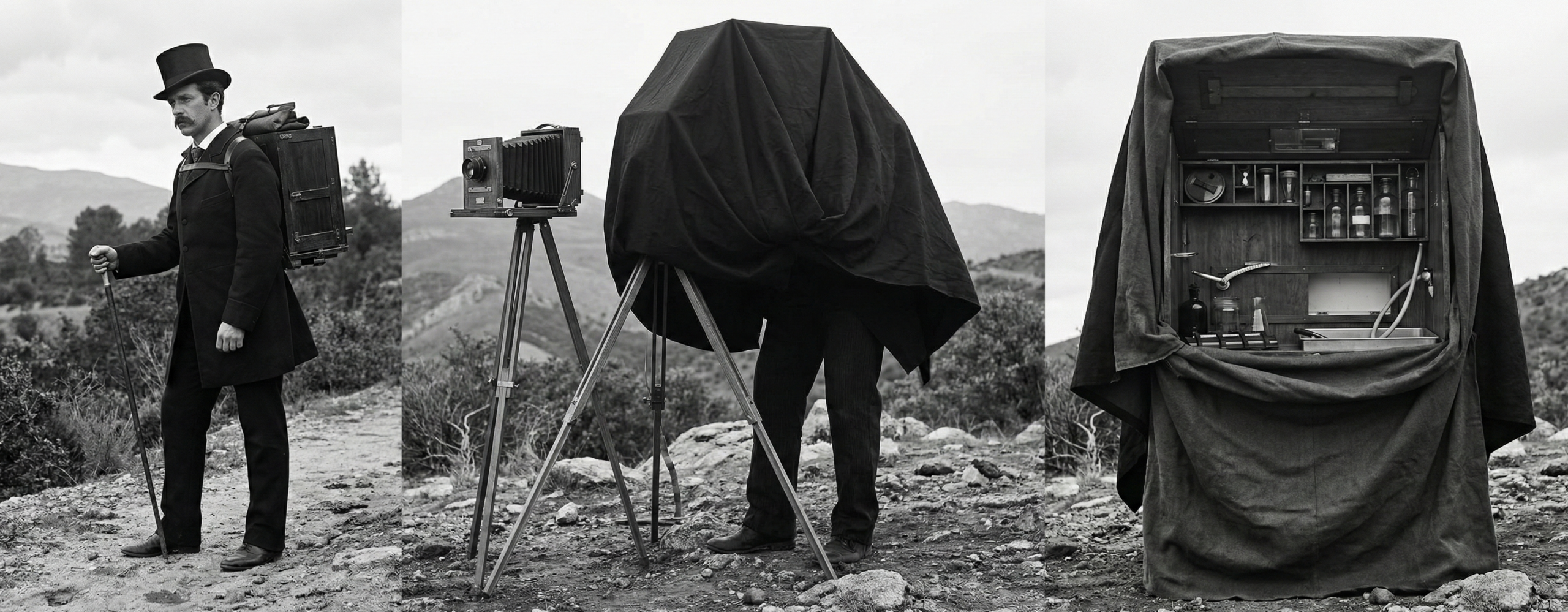
On a summer afternoon in the mid‑19th century, a photographer in the field might be racing the clock—glass plate in hand, chemicals ready, light fading—knowing that once the collodion dried, the image would be lost. Photography was already pushing beyond the studio. But it was still tethered to chemistry, timing, and physical constraints that resisted movement.
This tension mattered. Long before powered aircraft, humans were rising into the air in hot‑air balloons, seeing cities and landscapes from unfamiliar heights. Yet photography lagged behind flight. Early photographic processes demanded stillness: fixed architecture, controlled interiors, and subjects that could hold a pose. The sky, by contrast, was restless.
The breakthrough came in 1851 with the introduction of the wet plate collodion process. It sharply reducing exposure times, produced highly detailed glass negatives, and forced photographers to work with portable darkrooms. This new process transformed photography into a mobile, field‑ready practice. For the first time, making a usable photograph from a moving platform became technically feasible—and aerial photography entered the realm of experimentation.
Photography Before Wet Plate Collodion
To understand why wet plate collodion marked such a turning point, it helps to look at the tools photographers relied on before it appeared. Early photography could be visually stunning, but it was fundamentally grounded.
The most influential early process was the Daguerreotype, introduced in 1839. Daguerreotypes produced direct positive images on silver‑coated copper plates, capable of remarkable detail and tonal range. But they came at a cost. Exposure times were long, often stretching into minutes in the early years. And the finished image was a singular object—there was no negative and no easy way to reproduce it.
These constraints shaped how photography was practiced. Long exposures required motionless subjects. Complex chemical handling favored studios or carefully controlled outdoor settings. Even as photographers ventured into landscapes and city streets, they worked with scenes that could tolerate patience and stability.
Flight offered neither. Hot‑air balloons drifted, rotated, and responded to the wind. Asking a daguerreotype plate to remain sharp under those conditions was unrealistic. The limitation was not imagination or nerve; it was exposure time and chemistry.
The Invention of the Wet Plate Collodion Process
In 1851, English sculptor and amateur photographer Frederick Scott Archer published a new photographic method that quietly redefined the medium. The wet plate collodion process replaced expensive metal plates with glass negatives coated in a light‑sensitive collodion solution.
The method demanded precision and speed. A clean glass plate was coated with collodion, sensitized in a silver nitrate bath. It was then placed into the camera while still wet. After exposure—often just a few seconds in good daylight—the plate had to be developed immediately, before the collodion dried. This requirement forced photographers to carry their chemistry with them, relying on wagons, tents, or portable darkrooms.
The inconvenience was real, but so were the advantages. Wet plate collodion delivered images of exceptional sharpness at a fraction of the cost of daguerreotypes. Just as importantly, the glass negative allowed multiple prints from a single exposure. Photography became reproducible, practical, and increasingly systematic.
Why Wet Plate Collodion Changed Photography
The impact of wet plate collodion extended beyond image quality. It reshaped how photographers worked and how far they were willing to go.
Exposure times dropped enough to tolerate limited motion without sacrificing detail. Photographers could document landscapes, infrastructure, and events with a level of clarity that earlier processes struggled to achieve. The reproducible glass negative turned photographs into records rather than curiosities, suitable for comparison, study, and distribution.
Most significantly, wet plate collodion normalized photography as a field activity. Working under time pressure, managing chemicals outdoors, and adapting to unpredictable conditions became part of the craft. These habits would prove essential when photography began to leave the ground.
Why Aerial Photography Was Impossible Before Wet Plate Collodion
The desire to photograph the world from above existed long before the technology allowed it. What held photographers back was not the absence of flight, but the mismatch between motion and exposure.
Early photographic processes required exposures far too long to tolerate the constant movement of a balloon. Even small shifts in position would blur an image beyond recognition. Daguerreotypes were especially ill‑suited to aerial work, combining long exposure times with delicate handling and non‑reproducible results.
The instability of flight made practical aerial photography impossible until a process arrived that could shorten exposure, survive transport, and be executed quickly under pressure. Wet plate collodion did not eliminate the challenge, but it reduced it enough to make experimentation realistic.
Early Human Flight and the Hot‑Air Balloon
Before airplanes, balloons offered the only practical means of sustained human flight. They could lift observers, instruments, and—eventually—photographic equipment to heights that revealed entirely new perspectives.
For photographers, hot‑air balloons represented the first plausible aerial platforms. They allowed relatively smooth ascents and provided just enough space to operate a camera and manage equipment. At the same time, they introduced new difficulties: wind drift, rotation, vibration, and limited control over position.
The First Experiments in Aerial Photography
Once wet plate collodion made shorter exposures and portable workflows possible, photographers began testing the limits of photography in the air.
In 1858, French photographer and aeronautical enthusiast Nadar ascended in a hot‑air balloon over the outskirts of Paris and produced what is widely regarded as the first aerial photograph. The original image no longer survives, but contemporary accounts confirm that the attempt succeeded.
Nadar’s achievement was not a polished result but a proof of concept. He demonstrated that photography could function in flight—that a glass plate could be prepared, exposed, and developed under the constraints of altitude, motion, and time.
James Wallace Black and the Oldest Surviving Aerial Photograph
Two years later, aerial photography produced its most enduring early image.
In 1860, American photographer James Wallace Black, accompanied by balloonist Samuel Archer King, ascended over Boston and captured a series of wet plate exposures. One survived. Known as Boston, as the Eagle and the Wild Goose See It, it is widely recognized as the oldest surviving aerial photograph.
The image presents Boston not as a street‑level experience but as a system—shorelines, buildings, and streets arranged into a coherent pattern. Its survival is remarkable given the circumstances: fragile glass plates, chemical time limits, and an unstable platform suspended above the city.
How Wet Plate Collodion Shaped the Future of Aerial Photography
The technical lessons learned during these early experiments carried forward. Later innovations—dry plates, roll film, stabilized mounts, and aircraft‑based cameras—built directly on the foundation established in the wet plate era.
Wet plate collodion marked the moment photography became mobile enough to pursue new vantage points. It trained photographers to think operationally, to work quickly, and to accept environmental uncertainty as part of the process.
Why the Wet Plate Collodion Process Still Matters Today
Modern aerial imagery feels effortless by comparison, but it rests on a fragile chain of historical breakthroughs. Wet plate collodion was the catalyst that allowed photography to leave the ground.
Every aerial image taken since—from early balloon photographs to modern aerial surveys—traces its lineage back to that mid‑19th‑century alignment of chemistry, ambition, and altitude. The wet plate collodion process did not simply improve photography; it changed where photography could exist, and in doing so, changed how the world could be seen.