
On May 12, 1888, somewhere over a farm in southern France, a rubber band snapped. A shutter fired. A glass plate captured a road, a brook, and a bridge from 100 meters up — with no pilot, no balloon, no engine. Just a kite, a burning fuse, and a photographer standing on the ground below, waiting to see if his idea had worked. It had.
That’s where kite aerial photography began.
Before Kites: Balloons — and Why They Failed
Aerial photography began with balloons in the 1850s. They were expensive, dangerous, and extraordinarily difficult to control. Wet-plate photography demanded darkrooms in the sky. Hydrogen caught fire. Cables snapped. The whole enterprise required a crew, a fortune, and a willingness to die for a photograph.
By the 1880s, two changes shifted the equation. Dry-plate photography made unmanned exposures practical — no more on-site chemical processing. And improved kite designs made controlled lift achievable without a passenger. The kite was cheap, wind-powered, and operated entirely from the ground.
For the first time, aerial photography didn’t require a pilot. One photographer in rural France saw that opening and walked straight through it.
Arthur Batut and the Birth of a Method
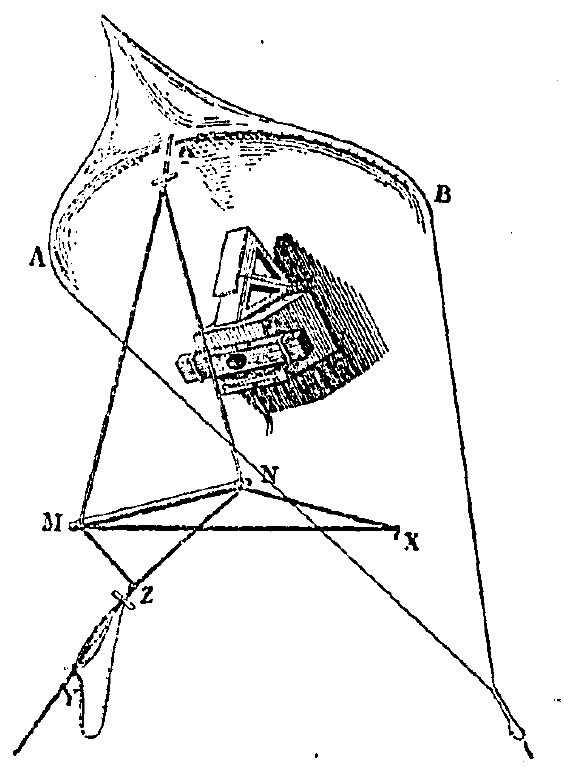
In 1888, Arthur Batut calculated how long it would take his kite to reach 100 meters, loaded a lightweight wooden camera with commercially available gelatin dry glass plates, cut a tinder wick to match that interval, and waited. When the flame burned through the thread, the shutter fired. The exposure would later be recognized as a turning point in photographic history.
That image — Le Chemin et le Ruisseau, a modest view of a road, a brook, and a bridge in rural southern France — is the first confirmed aerial photograph made from a kite. It isn’t dramatic. But it proved something that would echo through every aerial image made in the century that followed: a camera didn’t need a human in the sky. It needed lift, stability, and a trigger.
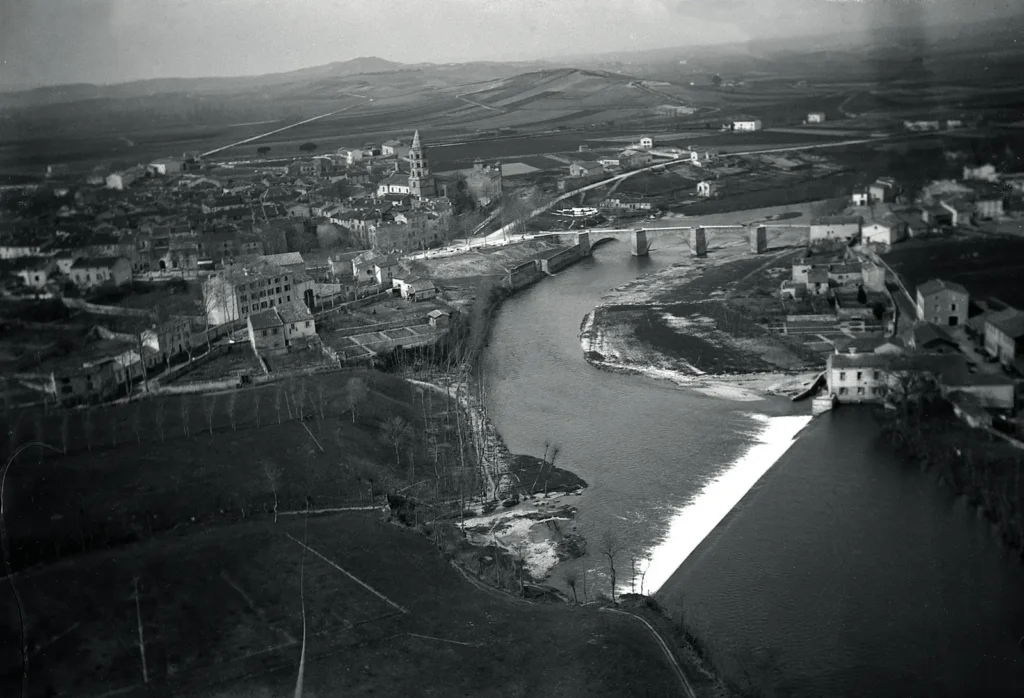
From Experiment to System
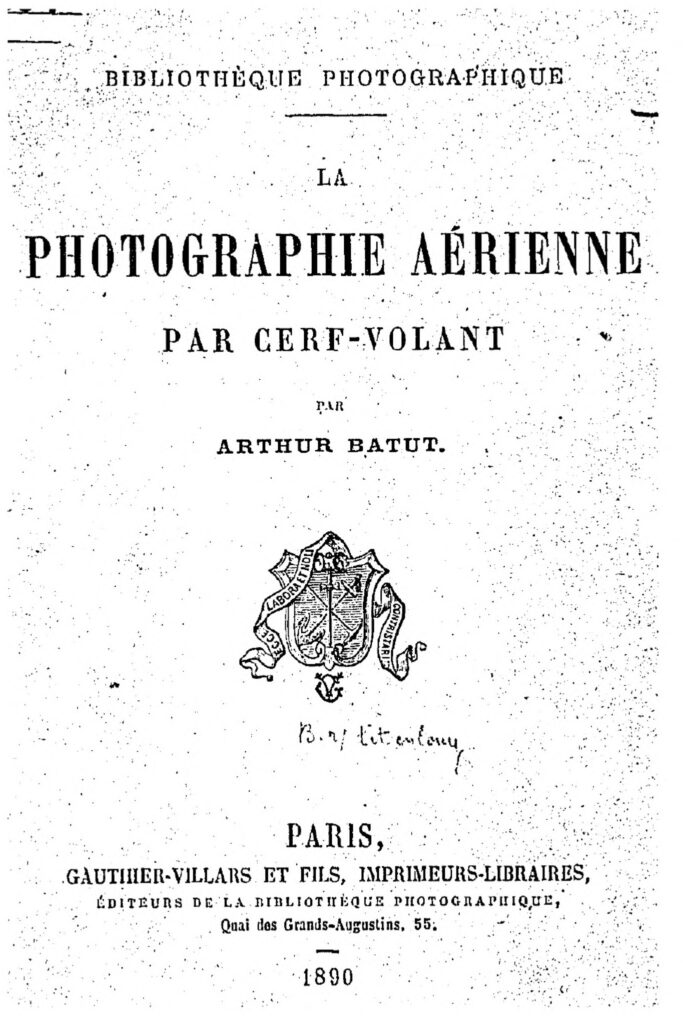
What made Batut remarkable was more than just the photograph; it was the system. He worked out the kite construction, the camera mounting, the fuse timing, and the wind assessment through careful trial and error — and then he wrote it all down. In 1890 he published La photographie aérienne par cerf-volant, the first practical manual devoted to kite aerial photography. He refined his shutter speed after early motion blur. He later experimented with stereoscopic pairs to enable terrain measurement.
Batut didn’t treat his work as spectacle. He treated it as a transferable system — one that surveyors, scientists, and military observers could replicate without reinventing it. That decision to publish transformed isolated experimentation into a practice. Every kite aerial photographer who came after him started with a shorter walk.
A Global Community Takes Flight
By the 1890s, kite aerial photography had spread across three continents. In the United States, William Abner Eddy developed a tailless diamond kite and in 1895 produced what is widely regarded as the first American kite aerial photograph. In Australia, Lawrence Hargrave‘s box-kite design of 1893 dramatically increased lift and stability, and became the foundation for the multi-kite trains that could haul heavy cameras thousands of feet up.
The mechanical problems were real. A camera swinging freely beneath a kite line produces blurred, unusable images. In 1912, French engineer Pierre Picavet solved this with an elegant self-leveling suspension — a system of pulleys and cords that kept the camera stable regardless of the kite line’s angle. Photographers still use the Picavet suspension today.
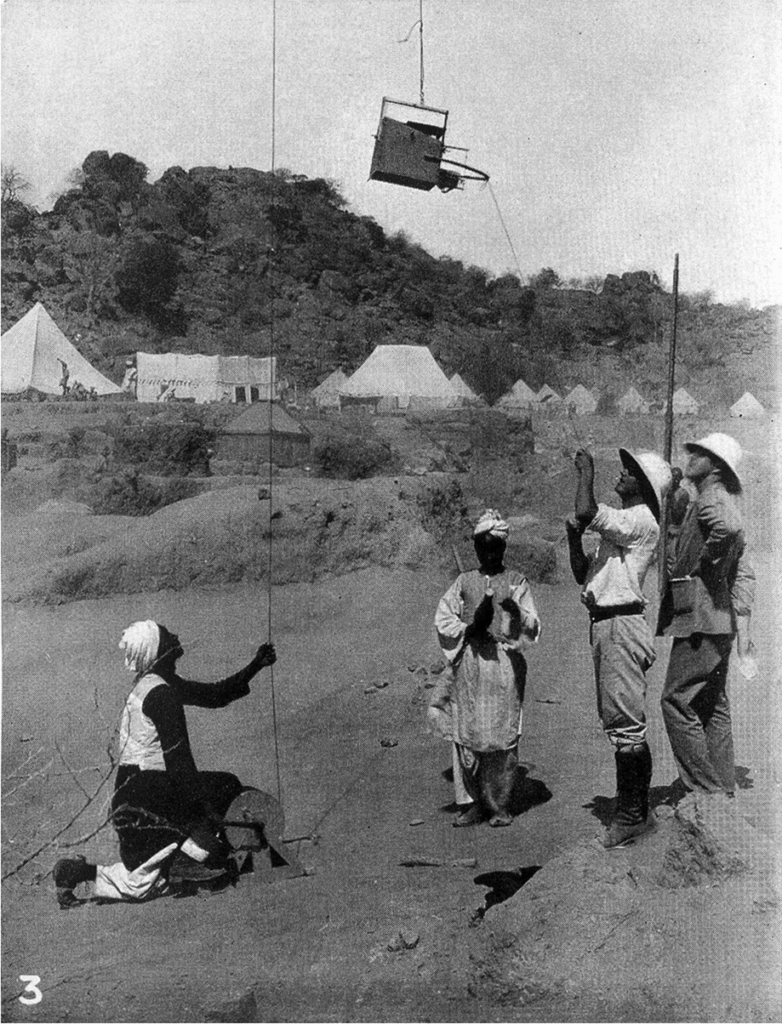
These weren’t hobbyists. Archaeologist Henry Wellcome applied kite photography to excavation mapping in Sudan, demonstrating that vertical aerial views could reveal patterns invisible from the ground. Military observers recognized the reconnaissance potential. The kite had become a measuring instrument.
Lawrence: Proof of Concept at Full Scale
George Lawrence’s 1906 panorama—taken from his “captive airship”—remains one of the most astonishing photographs of the 20th century. What it represents in this longer history on kite aerial photography is a demonstration of scale. Lawrence didn’t invent kite aerial photography. He proved what it could do when pushed to its limits — a 48-inch image, shot from nearly half a mile up, sharp enough to read signs on the waterfront and pick out figures in the rubble. He turned Batut’s modest proof of concept into a system capable of documenting a national disaster.
Lawrence also showed that the method had a ceiling. Airplanes, arriving just years later, offered altitude, range, and flexibility no kite train could match. By the 1910s, Lawrence had moved on to aviation patents. Aerial photography moved with him — into a new era, carried by engines instead of wind.
What the Kite Era Actually Built
The tools changed. The underlying principles didn’t. Every technique that defines modern aerial imaging — stability, vertical perspective, remote triggering, sufficient resolution to support measurement — was tested and refined in the kite era, years before the first reconnaissance aircraft flew over the Western Front.
Batut proved a camera could be controlled without a human in the sky. Hargrave’s kites proved that lift could be scaled. Picavet’s suspension proved that stability could be engineered. Lawrence proved the whole system could produce images of national consequence.
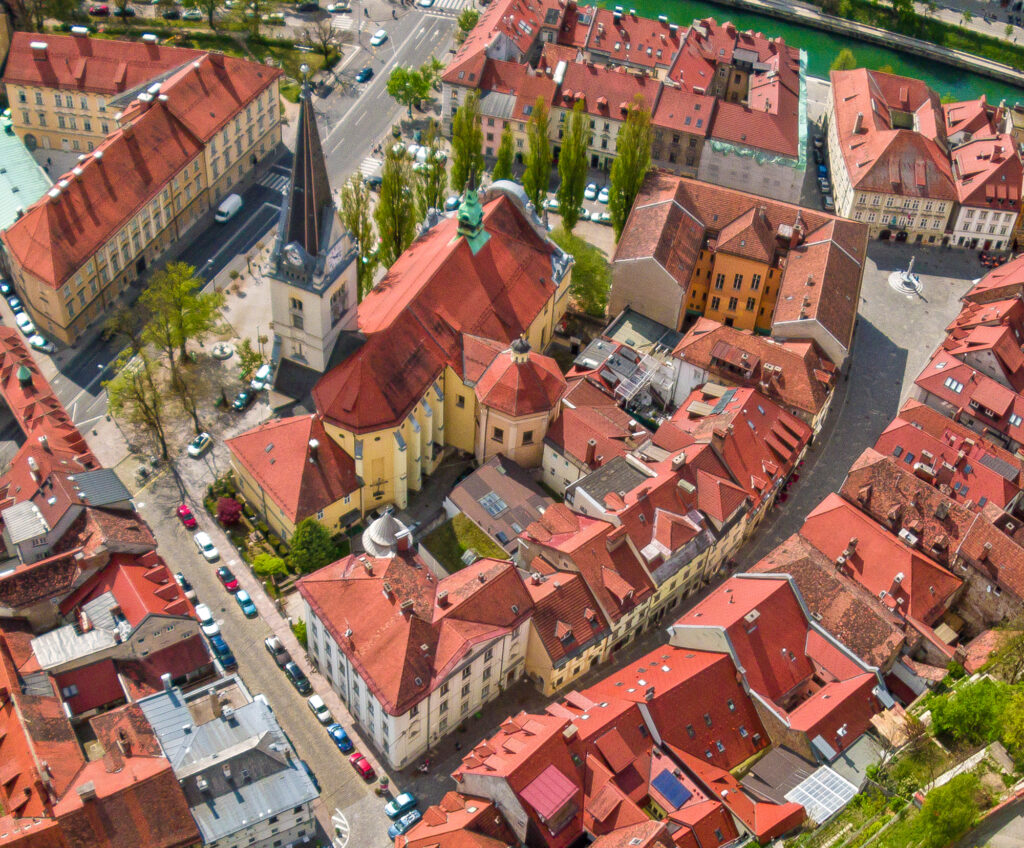
Kite aerial photography never disappeared. Modern practitioners — including groups like KAP Jasa in Slovenia, which conducts mapping and artistic projects with kite-suspended digital cameras — point to real advantages: minimal regulatory friction, near-silent operation, and exceptional stability in steady wind. In certain conditions, a kite remains the most practical tool available.
But the deeper legacy is conceptual. Detach the camera from the ground. Stabilize it. Trigger it remotely. Let perspective reveal what ground-level observation cannot.
A fuse burning down in rural France in 1888 set that idea in motion. Everything since has been refinement.