
Why 1930 Sanborn Maps are in now in the public domain…and how the rules actually work
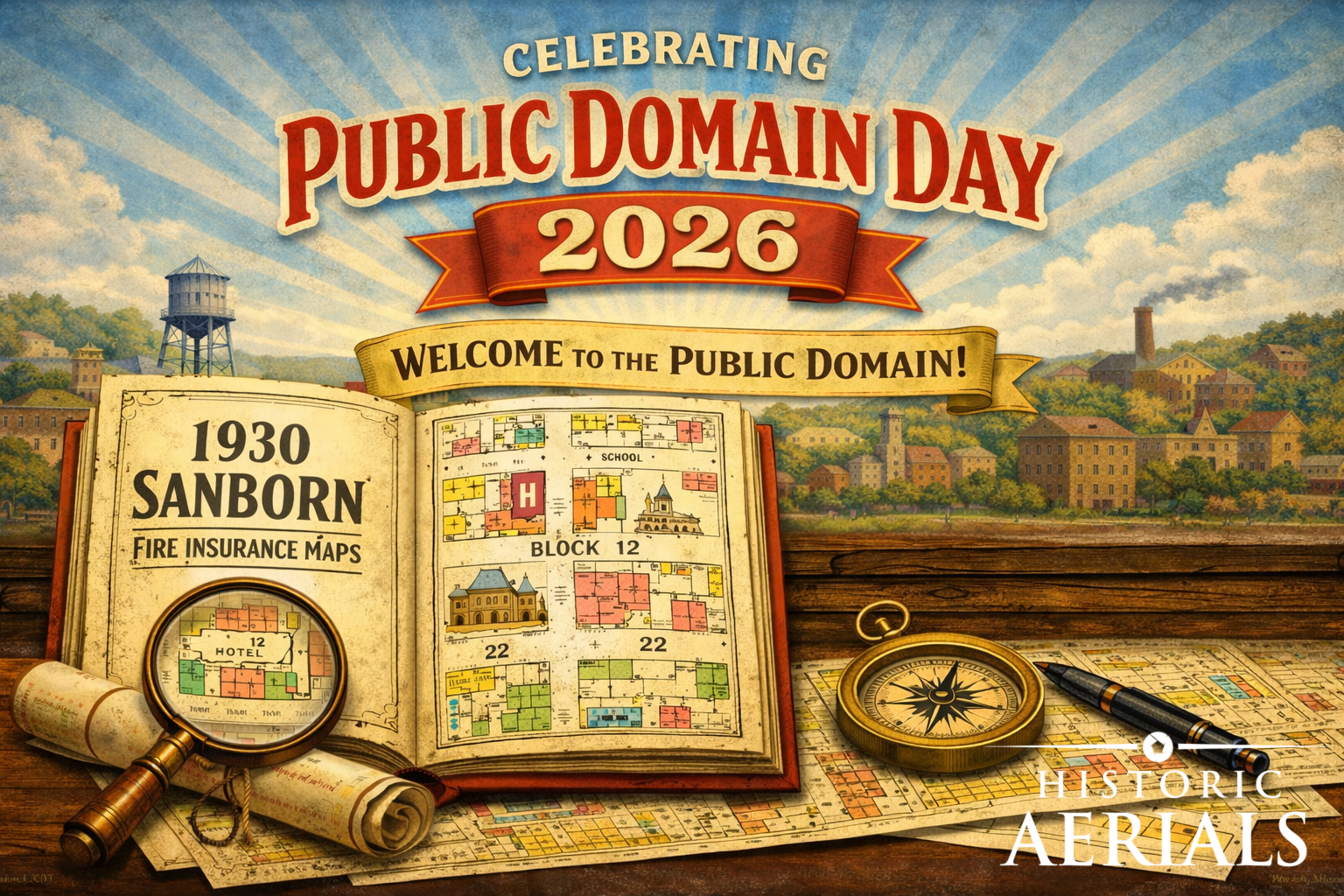
Every January 1, a quiet but meaningful shift occurs in the historical record. Another year’s worth of creative works (books, photographs, films, sheet music, and maps) cross an invisible legal threshold and become part of the public domain. On January 1, 2026, that threshold moved again. Works first published in 1930 are now free for anyone to use, reproduce, analyze, and republish without permission.
For historians, genealogists, preservationists, and map researchers—especially those working with property records, parcel data, and land-use history—that matters in a very specific way: the public-domain rules governing Sanborn Fire Insurance Maps—especially those published in 1930—have now changed.
That statement is true—but only if you understand how U.S. copyright law actually works. And that law is far more complicated than “95 years from publication.” Let’s unpack why 1930 is the magic year, why January 1 matters, and why Sanborn maps sit in a uniquely confusing corner of copyright history.
The simple rule everyone hears (and why it’s incomplete)
You’ll often see public-domain explanations boiled down to a single sentence:
“Copyright lasts 95 years.”
That’s not wrong—but it’s dangerously incomplete.
Under current U.S. law, most published works created by corporations between 1923 and 1963 can be protected for up to 95 years. But that full term only applies if certain legal steps were taken decades ago. Miss those steps, and the work entered the public domain early (sometimes shockingly early).
Sanborn maps fall squarely into this gray area.
Why January 1 is the only date that matters
Copyright expiration in the United States follows what’s known as the “end of the calendar year” rule.
That means:
- Copyright does not expire on the anniversary of publication.
- It runs through December 31 of the final year.
- The work becomes public domain at 12:01 a.m. on January 1 of the following year.
So while a 1930 work technically completes its 95th year sometime in 2025, it does not enter the public domain until January 1, 2026.
This is why Public Domain Day exists—and why every January 1 unlocks an entire year’s worth of material at once.
Why Sanborn Maps are especially tricky
The Sanborn Map Company produced thousands of large-format, highly detailed urban maps for the insurance industry. These were commercial works, published regularly, and frequently revised.
From a copyright standpoint, that puts them in the most complicated category possible:
- Corporate authorship
- Published works
- Issued during the era when copyright renewal was mandatory
In other words, you can’t assume anything. You have to understand the renewal system.
The key concept: copyright used to be opt-in
Today, copyright is automatic. Create something, and it’s protected.
That was not always the case.
For much of the 20th century, U.S. copyright was effectively an opt-in system beyond an initial term. Owners had to file paperwork—or lose their rights forever.
This is why the rules differ so dramatically depending on the decade in which a work was published.
Era 1: the “Must Renew” period (1923–1963)
This is the era that governs 1930 Sanborn maps.
How it worked:
- Initial term: 28 years from publication
- Renewal requirement: In the 28th year, the copyright owner had to file a formal renewal with the U.S. Copyright Office.
- If renewed: The work received a second term (eventually extended to bring the total to 95 years).
- If not renewed: The work fell into the public domain immediately after the first 28 years.
The trap:
Most publishers failed to renew. Studies of books, maps, and similar works suggest that roughly 85% were never renewed. Once that renewal window closed, there was no fix, no appeal, and no retroactive protection.
What this means for 1930 Sanborn maps:
- Renewal would have been due in 1957 or 1958.
- If Sanborn filed the paperwork, the map remained protected until January 1, 2026.
- If they did not, that map has been public domain since 1958.
This is why you’ll see some 1930 (and even later) editions that became openly available decades ago (and increasingly on the internet), while others are only becoming usable now — in many cases simply because no one verified whether the copyright had been renewed, or because users were reluctant to take the legal risk.
The complicating factor: Revision Slips vs. new publications:
Many Sanborn sheets from the 1930s were not newly published works, but earlier maps that had been updated with paste-on revision slips. In those cases, the underlying sheet may have been printed years earlier, even though it carries a later “corrected to” or revision date. For copyright purposes, the status of these maps generally follows the publication and renewal history of the original base sheet — the stickers did not restart the copyright clock or create a new term.
Era 2: automatic renewal (1964–1977)
Congress eventually realized that creators were losing rights simply because they missed a filing deadline.
So the law changed.
For works published between 1964 and 1977:
- Renewal became automatic.
- No paperwork was required.
- Nearly all of these works remain protected for the full 95-year term.
For researchers, this is the “dead zone.” Almost nothing from this era accidentally slipped into the public domain early.
Era 3: the modern system (1978–present)
The 1976 Copyright Act rewrote the rules entirely.
For works created after January 1, 1978:
- No renewal system exists.
- Protection is based on life of the author + 70 years, or
- 95 years from publication for corporate works.
This system is simpler—but much longer.
How we got to “95 years” in the first place
Originally, copyright terms were much shorter. The expansion to 95 years happened in stages:
- Original second term: 28 years
- Extended to 47 years
- Extended again to 67 years (via the 1998 Copyright Term Extension Act)
Add that to the original 28-year term:
28 + 67 = 95 years
That final extension is often nicknamed the “Mickey Mouse Protection Act,” but it applies broadly—maps included.
What’s Public Domain as of January 1, 2026?
Here’s the updated, practical breakdown.
Summary Table for Historians and Researchers (2026)
| Date of Publication | Renewal Rule | Current Status (as of Jan 1, 2026) |
| 1930 and earlier | Term expired | Public Domain (safe to use) |
| 1931–1963 | Renewal required | Mixed: Public domain if not renewed; protected for 95 years if renewed |
| 1964–1977 | Automatic renewal | Protected for 95 years |
| 1978–Present | No renewal system | Protected (Life + 70, or 95 for corporate works) |
What this means in practice for Sanborn Maps
For 1930 and earlier Sanborn maps, the landscape just changed:
- All renewed 1930 Sanborn maps became public domain on January 1, 2026.
- Any unrenewed maps have been public domain for decades.
- The practical effect is that 1930 now functions as a clean cutoff year for safe use.
For later maps, especially those from the 1940s and 1950s, renewal research still matters. The question remains the same:
Did someone file that piece of paper in the 28th year?
If yes, wait out the clock. If no, history has already handed you the keys.
The bottom line
Public Domain Day isn’t only a celebration. It has real, practical consequences for what you can legally do. As of January 1, 2026, an enormous body of historically rich cartographic material crossed a legal boundary that had nothing to do with creativity, value, or relevance, and everything to do with paperwork filed nearly seventy years ago.
For researchers working with Sanborn maps, understanding these rules isn’t academic trivia. It determines what you can publish, share, annotate, and build upon—confidently and legally.
And now, at last, 1930 belongs to everyone.
A Copyright Cliffhanger: Two #1 Hits, Forty Years Apart (Legally)
As a postscript to all of this legal machinery, it’s worth pausing on what may be the most dramatic “before and after” moment in modern copyright history. It doesn’t involve maps or books—but it perfectly illustrates how abrupt the 1978 shift really was.
In December 1978, two songs hit #1 on the Billboard charts in consecutive weeks. To listeners, they belonged to the same cultural moment. To copyright law, they might as well come from different centuries.
| “Old Rules” Hit | “New Rules” Hit | |
| Song | You Don’t Bring Me Flowers | Le Freak |
| Artist | Barbra Streisand & Neil Diamond | Chic |
| Billboard #1 Date | Dec 2, 1978 | Dec 9, 1978 |
| Copyright Era | 1909 Act | 1976 Act |
The 1977 song: “You Don’t Bring Me Flowers”
Although the famous duet topped the charts in late 1978, the composition was first released on Neil Diamond’s solo album I’m Glad You’re Here With Me Tonight in November 1977. That single fact locks it into the old system.
- Rule: Fixed 95-year term from publication
- Math: 1977 + 95 = 2072
- Public Domain: January 1, 2073
- Certainty: Absolute. The date is known and immovable.
The 1978 song: “Le Freak”
Music lore holds that Nile Rodgers and Bernard Edwards wrote “Le Freak” on January 1, 1978, the very first day the new copyright law took effect. That timing changed everything.
- Rule: Life of the author + 70 years
- Key author: Nile Rodgers, still living
- Status: The copyright clock hasn’t even started yet
- Hypothetical: If Rodgers lived to 90, the song wouldn’t enter the public domain until 2113
The result
These two songs were played back-to-back on the radio in December 1978. Yet because one crossed an invisible legal line by a matter of weeks, “You Don’t Bring Me Flowers” will almost certainly enter the public domain roughly forty years before “Le Freak.”
It’s a reminder that copyright history isn’t gradual. Sometimes it turns on a single date—and everything on either side of it lives very different legal lives.